Close your eyes and envision the ideal, manicured lawn. Do you see a sprawling expanse of emerald turf grass, lush and healthy with nary a dandelion in sight? Sure hope you live near the Isle of Skye. “If you try to grow turf grass in an arid climate, you will need to create an artificial Scotland to replace the many inches of rainfall the grass needs but doesn’t receive,” says Dakota Petersen, a lifelong resident of the Sonoran Desert who has participated in several landscape restoration projects around Phoenix and Scottsdale and at Cosanti Originals, where he acts as the outreach and development ambassador. “This can be very costly to maintain and wastes water, our most important resource.”
So, if you don’t have a pet Highland cow and the only time you’ve donned a kilt was that year you dressed as William Wallace for Halloween, it’s time to explore the low-water landscaping method known as xeriscaping. Not only will you save a bundle on your monthly water bill; you’ll also have less active yard maintenance, and you can dramatically increase your home’s curb appeal. “Leave the grass to the cows,” Petersen says, “and keep for yourself a xeriscape that will provide sustainable, responsible delight for many years to come.”
Read on to find expert tips for xeric landscaping design, key principles to keep in mind, and plenty of xeriscape ideas and photos for inspiration.
What Is Xeriscaping?
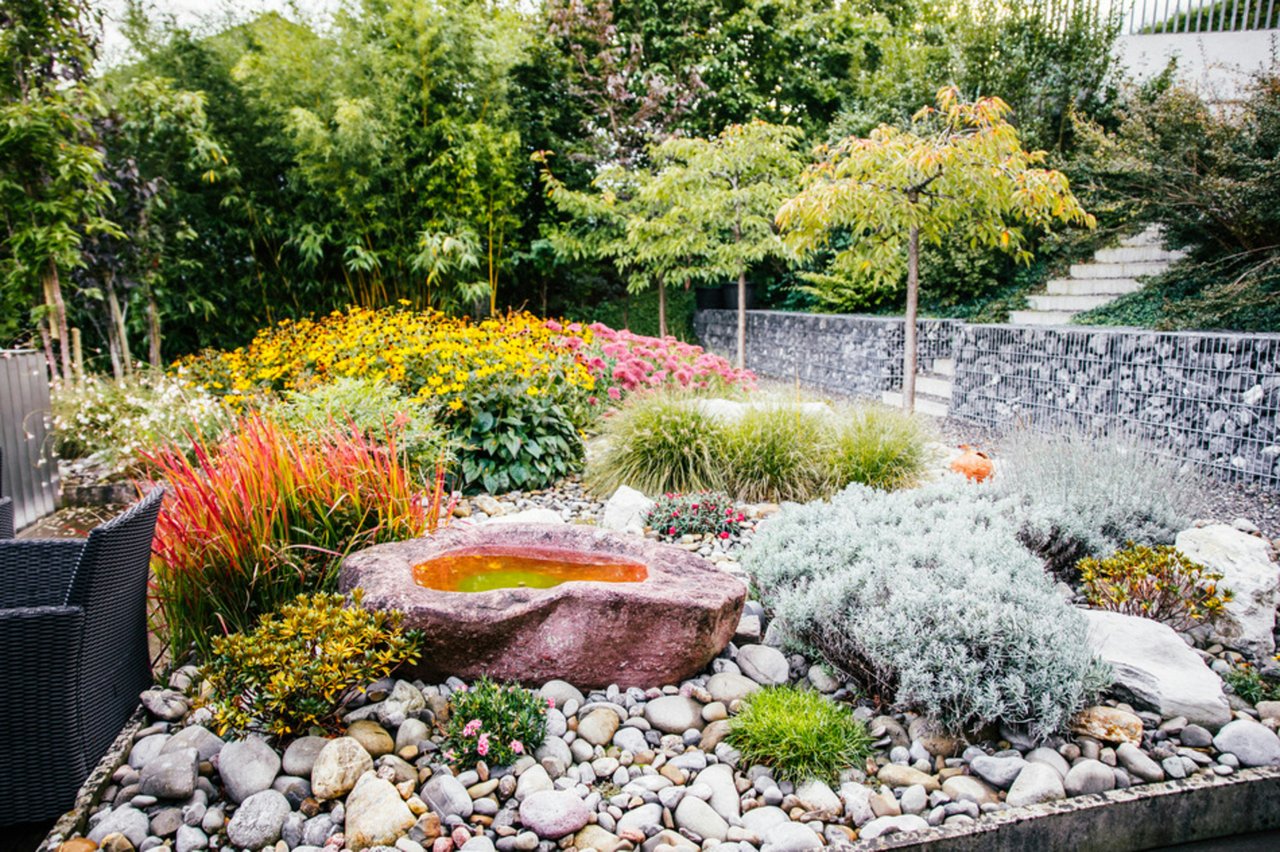
Xeriscaping is a water-efficient landscaping method that replaces the traditional plants and grassy lawn, known as a turf lawn, with plants that have low water needs, often native species and those adapted to arid environments. Many adopters also incorporate hardscaping elements (think boulders, flagstone patios, and gravel paths) that further reduce maintenance while boosting your garden’s functionality, sustainability, and climate resilience.
Don’t fret if you’re a guy who digs a lush and colorful lawn. “Xeriscaping doesn’t–and shouldn’t–just mean a yard full of scorching hot rock with a couple token plants thrown in,” says Jack Dash, the gardens and facilities manager at Tucson’s Tohono Chul Sonoran Botanic Garden and Arboretum and author of The Southwest Native Plant Primer. “Creating a multilayered garden that makes use of trees, shrubs, perennials, cacti, and grasses will allow you to blend beautiful colors and textures while shading and cooling the soil.”
In other words: Don’t confuse xeriscaping with zeroscaping, which involves replacing grass and other plants with a yard covered in dirt, gravel, or river rocks. That tactic will also reduce your water consumption, but it may reduce your home’s aesthetics along with it.
Key Xeriscaping Principles
Design for minimal water usage.
Start with a plan that embraces an arid environment using native and low-water plants and reduction (or elimination) of turf grass. Factor in the microclimates within your yard like the corner shaded by your house and the front yard that bakes in the sun.
Prepare the soil.
Decide how significantly you will change, or amend, the soil in your yard. This will depend on your soils’ natural composition, your desired aesthetic and preferred plants, and your budget, notes Annie Shaw, co-founder of Xeric Oasis, a San Francisco-based sustainable landscape design firm and 2025 Best of Houzz award-winner. Amending the soil, at least to some extent, will likely open the pallet of plants suitable for your environment. If you have heavy clay in your yard, consider creating berms or raised beds of fast-draining soil to suit the type of plants you’d like to grow, she adds.
Water efficiently.
Drip irrigation systems distribute water directly to the roots through a series of small underground tubes. Valves called emitters control how much water the plant gets, effectively creating a slow drip rather than a spray or stream. Smart drip irrigation systems have controllers and sensors that further cater the water distribution to the plant’s specific needs, unlike traditional automatic timer systems that run on a fixed schedule, notes Angelica Elliott, assistant director of public horticulture at Desert Botanical Garden in Phoenix. Elliott also suggests using separate irrigation lines for each distinct type of plant life, e.g., one for trees, one for shrubs, etc.
Many landscape architects advise grouping plants by their water needs, a practice known as “hydrozoning.” This helps to simplify the irrigation system but may limit your ability to be creative with the landscape design.